parserpick
Technischer Gesundheits-, Sicherheits-, Governance- und Engineering-Bericht für parserpick (v0.1.2).

Downloads & Community-Verbreitung
Gesundheits- & Engineering-Analyse (5 Säulen)
1. Governance & Community100 / 200 ▾
2. PEP-Metadaten & Paketierung200 / 200 ▾
3. Sicherheit & Lieferkette150 / 200 ▾
4. Dokumentation, SEO & Ökosystem105 / 200 ▾
5. Engineering, CI & Qualität200 / 200 ▾
Documentação Oficial & Guia de Uso — parserpick
Exibir documentação original completa (README em Inglês) ▾
parserpick
English | 한국어
Pick the right --tool-call-parser, --reasoning-parser and --chat-template flags for vLLM or SGLang from a model's chat template, before you start the server. When a tool call goes missing, replay the raw output offline and see where it leaked. No GPU, no server, no API key.
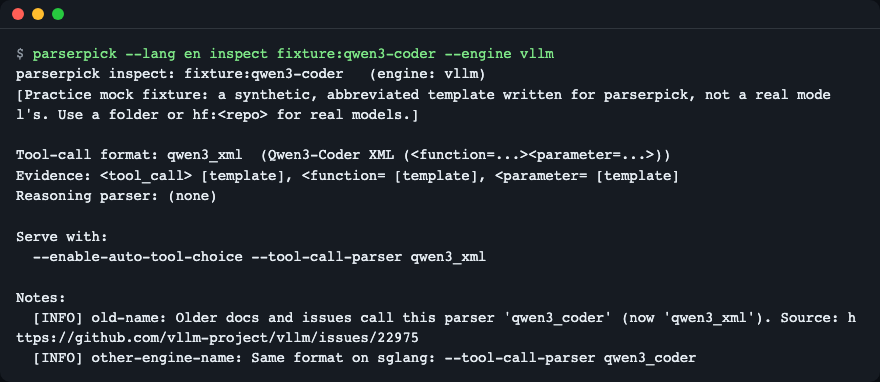
parserpick inspect reads a template, names the tool-call format, and prints the flags to serve with. This run uses a built-in practice (mock) template.
Who is this for
- You are about to serve a new open model (or your own fine-tune) with vLLM or SGLang and do not want to dig through a per-model parser table.
- Your agent gets
tool_calls: []and the call text shows up incontentor inside the reasoning block, and you want to know why. - You switched engine (vLLM to SGLang) or upgraded, and parser names changed.
- You changed a chat template and want a quick check that tool definitions and past tool calls still render.
Install
# prerequisite: uv (https://docs.astral.sh/uv/), it also fetches a suitable Python (3.11+)
curl -LsSf https://astral.sh/uv/install.sh | sh
# parserpick itself (needs git on a minimal Linux image: apt-get install -y git curl)
uv tool install git+https://github.com/LeeGyeongPil/parserpick
Try it without installing: uvx --from git+https://github.com/LeeGyeongPil/parserpick parserpick demo.
Or from a clone: git clone https://github.com/LeeGyeongPil/parserpick && cd parserpick && uv run parserpick demo.
The only runtime dependency is jinja2.
Quick start
Run the offline walkthrough first. It uses built-in practice (mock) fixtures: short synthetic templates and captured outputs written for parserpick, not copies of real models. They go through the same code paths as real model folders, but the real templates are longer, so check a real model before you trust a flag line.
parserpick demo
Then point it at your own model, a local folder or a Hugging Face repo:
parserpick inspect ./my-model
parserpick inspect hf:Qwen/Qwen3-Coder-30B-A3B-Instruct --engine sglang
Output for a folder holding a Qwen3-Coder-style template (SGLang):
parserpick inspect: my-model   (engine: sglang)

Tool-call format: qwen3_xml  (Qwen3-Coder XML (<function=...><parameter=...>))
Evidence: <tool_call> [template], <function= [template], <parameter= [template]
Reasoning parser: (none)

Serve with:
  --tool-call-parser qwen3_coder

Notes:
  [INFO] other-engine-name: Same format on vllm: --enable-auto-tool-choice --tool-call-parser qwen3_xml
- Tool-call format: which text shape the model writes when it calls a tool. It is decided from markers in the template and tokenizer, never from the model name, so a renamed fine-tune gets the same answer.
- Evidence: the markers that decided it.
<tool_call>alone would mean Hermes style; together with<function=and<parameter=it means the Qwen3-Coder XML style. - Serve with: paste these flags into your
vllm serveor SGLang launch command. The same format has different parser names per engine (qwen3_xmlon vLLM,qwen3_coderon SGLang), which is why the engine matters. Formats with no parser name in that engine's docs get no tool-call flags at all (vLLM refuses to start when--enable-auto-tool-choicecomes without--tool-call-parser), only ano-engine-parserwarning.
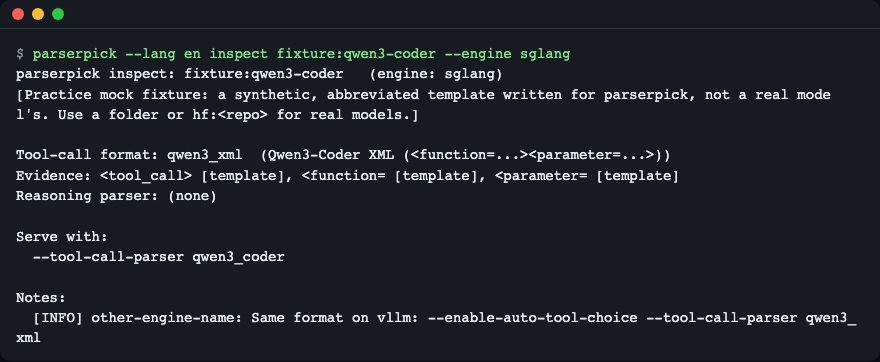 Same template,
--engine sglang: the parser name changes to qwen3_coder.
Usage
| Command | What it does | Example |
|---|---|---|
parserpick inspect SOURCE |
Judge the format, print serve flags and warnings | parserpick inspect ./my-model --engine vllm |
parserpick replay CAPTURE |
Re-run captured raw output: split reasoning, extract tool calls, diagnose | parserpick replay capture.txt --model ./my-model |
parserpick check-template SOURCE |
Render the template with five message shapes tool clients send | parserpick check-template ./my-model |
parserpick demo |
Offline walkthrough on practice fixtures | parserpick demo |
SOURCE is a model folder (with tokenizer_config.json and/or chat_template.jinja), hf:<org>/<repo>[@revision], or fixture:<name> (built-in practice template). CAPTURE is a text file, a /v1/completions JSON response, or fixture:<name>.
Common options: --engine vllm|sglang (default vllm), --engine-version V (warns if it differs from the versions the table was checked against), --format NAME and --reasoning NAME for replay (vLLM, SGLang and older names all work), --json for machine-readable output, --lang en|ko.
Exit codes: 0 fine, 1 a problem was found (FAIL, an error-level diagnosis, or an unknown format), 2 bad input, 4 download failed. This makes check-template and replay usable in CI.
Scenario 1: a template that never shows tools to the model
parserpick inspect fixture:deepseek-v31
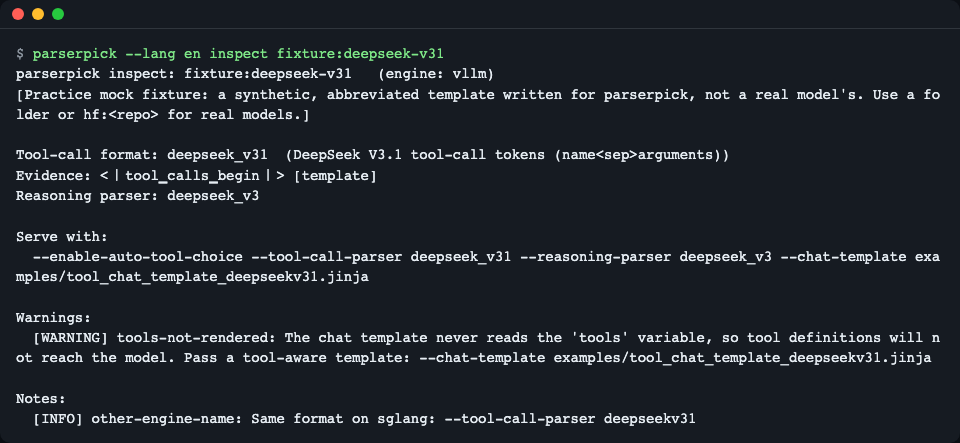 The flags include a tool-aware
--chat-template, and the warning says why: this template never reads tools, so the model would never see your tool definitions. The examples/... path is a file inside the vLLM source repository (see its examples folder); download it and pass its path. SGLang's templates live in its repository's examples/chat_template/.
Scenario 2: the call is inside the thinking block
Save the raw text the server produced (for example from /v1/completions) into a file and replay it. The built-in capture b_call_in_think stands in for that:
parserpick replay fixture:b_call_in_think --model fixture:qwen3
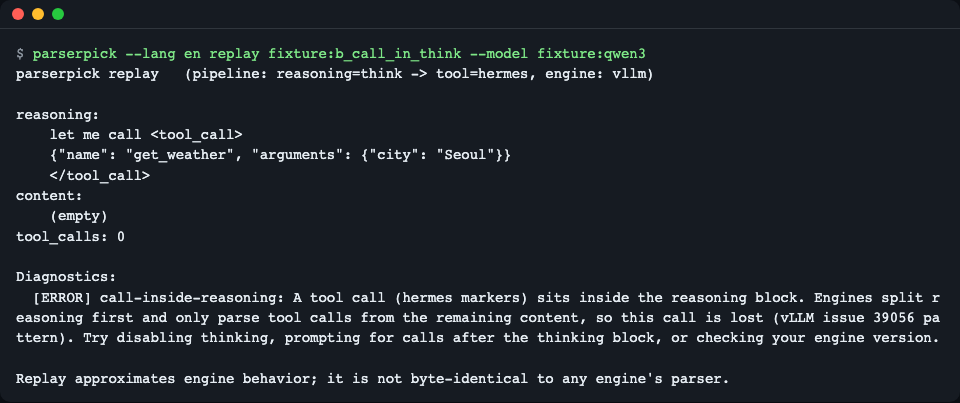 Engines split reasoning first and parse tool calls only from what remains, so a call written inside
<think> is lost. The diagnosis is call-inside-reasoning.
Scenario 3: the wrong parser was chosen
parserpick replay fixture:c_qwen3_xml --format hermes
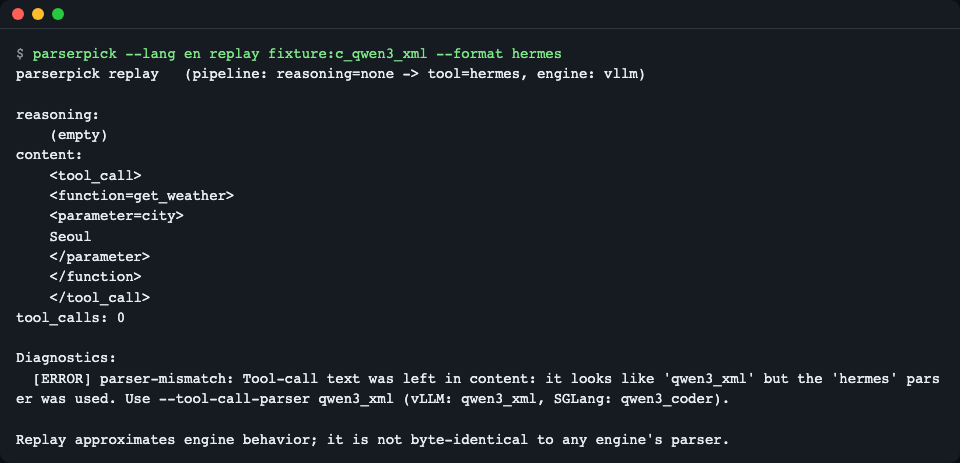 The server still starts with a wrong parser, it just returns
tool_calls: 0. parser-mismatch names the parser that fits, for both engines.
Scenario 4: check a template for tool-client message shapes
parserpick check-template fixture:mistral
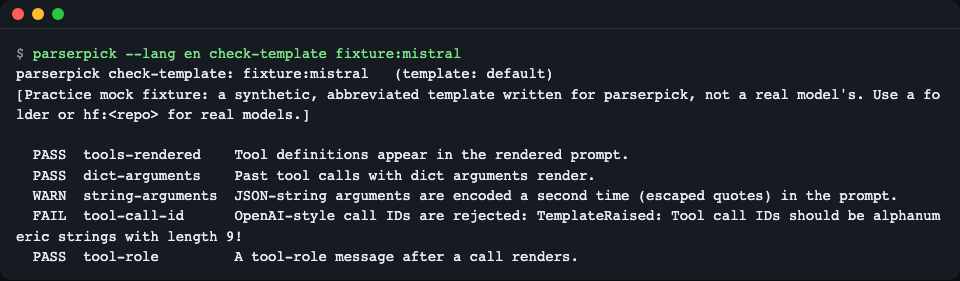 The template is rendered in Jinja's sandbox with five message shapes. Here OpenAI-style call IDs are rejected (FAIL) and JSON-string arguments are escaped twice (WARN).
Replay diagnostics: call-inside-reasoning, parser-mismatch, broken-arguments, unclosed-call (often max_tokens or a stop string), no-call, text-mixed-pythonic.
Configuration
parserpick needs no key and no GPU. Everything is optional (see .env.example):
| Variable | Purpose |
|---|---|
PARSERPICK_LANG |
UI language en or ko. Order: --lang, then this, then LC_ALL, LC_MESSAGES, LANG, otherwise English. |
HF_TOKEN |
Bearer token for gated Hugging Face repos with hf: sources. |
HF_ENDPOINT |
Hugging Face base URL or mirror (default https://huggingface.co). |
Switch language per call: parserpick --lang ko inspect fixture:qwen3. JSON output keeps keys and codes language-independent; only message is translated.
The format table (see Supported formats) lives in src/parserpick/data/formats.toml. Parser names were checked against the vLLM 0.34.0 and SGLang 0.5.23 documentation on 2026-11-19; each entry carries its check date. Adding a family is a data change there plus one rule in fingerprint.py and a format.<family>.label entry in both message tables (locales/en.json, locales/ko.json).
How it works
flowchart LR
  M[Model folder or hf repo] --> T[Chat template + tokenizer markers]
  T --> F[Fingerprint rules]
  F --> I[inspect: flags + warnings]
  T --> C[check-template: sandbox renders]
  R[Captured raw output] --> S[Split reasoning]
  S --> X[Extract tool calls]
  X --> D[Diagnosis]
- The template and special tokens are read from the folder (or downloaded with plain HTTPS GETs for
hf:). - Fingerprint rules combine several markers by priority.
<tool_call>alone is Hermes,<tool_call>plus<arg_key>is GLM, plus<function=and<parameter=is Qwen3-Coder. - The format maps to parser names per engine and version from the data table, and unlisted names are said so instead of guessed.
replayfollows the engine order: reasoning is split first, then tool calls are extracted from the rest. That order is why a call inside<think>disappears.replayapproximates engine behaviour, it is not byte-identical to any engine's parser. Confirm a fix against your real server.
Supported formats
12 tool-call families. "Decided by" lists the main markers parserpick looks for in the template or tokenizer. "Replay" says whether parserpick replay can extract calls from raw output of that family; the other three are judged by inspect only. - means the family has no reasoning parser in the docs, and "no documented name" means the engine docs list no parser for it (parserpick prints no tool-call flags for it, and on vLLM leaves --enable-auto-tool-choice out too, and warns instead of guessing). Some of these names exist in engine code (vLLM minimax_m2, SGLang minimax-m2) but are not documented and not checked by replay, so they are not recommended yet.
| Family (example models) | Decided by | vLLM --tool-call-parser |
SGLang --tool-call-parser |
Reasoning parser (vLLM / SGLang) | Replay |
|---|---|---|---|---|---|
hermes (Qwen2.5, Qwen3, Hermes) |
<tool_call> |
hermes |
qwen |
qwen3 / qwen3 |
yes |
qwen3_xml (Qwen3-Coder) |
<tool_call> + <function= + <parameter= |
qwen3_xml |
qwen3_coder |
- | yes |
glm45 (GLM-4.5, 4.6) |
<tool_call> + <arg_key> |
glm45 |
glm |
glm45 / - |
yes |
llama3_json (Llama 3.1-3.3) |
<|python_tag|>, "parameters" |
llama3_json |
llama3 |
- | yes |
pythonic (Llama 4, ToolACE) |
[func(...)] call list |
pythonic |
pythonic |
- | yes |
mistral (Mistral-7B v0.3) |
[TOOL_CALLS] |
mistral |
mistral |
- | yes |
deepseek_v3 (V3, R1) |
tool-call tokens + function<sep> |
deepseek_v3 |
deepseekv3 |
deepseek_r1 / deepseek-r1 |
yes |
deepseek_v31 (V3.1) |
tool-call tokens, name then arguments | deepseek_v31 |
deepseekv31 |
deepseek_v3 / deepseek-v3 |
yes |
kimi_k2 (Kimi-K2) |
<|tool_calls_section_begin|> |
kimi_k2 |
kimi_k2 |
- | yes |
openai (gpt-oss) |
<|channel|> (harmony) |
openai |
gpt-oss |
openai_gptoss / gpt-oss |
no |
granite (Granite 3.x) |
<|tool_call|> |
granite |
no documented name | - | no |
minimax (MiniMax-M2) |
<minimax:tool_call> |
no documented name | no documented name | minimax_m2_append_think / - |
no |
The same format gets different names on the two engines (qwen3_xml vs qwen3_coder, hermes vs qwen, glm45 vs glm, deepseek_v31 vs deepseekv31, openai vs gpt-oss). Checked against the vLLM 0.34.0 and SGLang 0.5.23 documentation on 2026-11-19: vLLM tool calling, SGLang tool parser. The source of truth is formats.toml.
When to use it
- Good fit: choosing or re-checking serve flags for a model, debugging a leaked tool call from a saved raw output, CI checks for template edits.
- It does not talk to a running server. To test a live OpenAI-compatible endpoint over HTTP, use toolcall-conformance; parserpick covers the step before the server starts.
- Judgement was checked on 12 built-in template families and a set of real Hugging Face templates on 2026-11-19. A new model family may show
unknown-format(exit code 1) until a rule is added.
Limits
- Approximate replay.
replayis a clean-room approximation of the engine parsers, not byte-identical to them. Confirm a fix against your real server. - No streaming. Incremental (streaming) parsing is not reproduced, so a bug that only appears with
stream=truewill not show up inreplay. - Replay covers 9 formats.
openai(harmony),graniteandminimaxare judged byinspectonly; replay for them is planned for a later version. - Names can change. Parser names are as of the check date above and may change between engine versions. Passing
--engine-versionwith a version the table was not checked against prints a warning. - Unseen templates. A template parserpick has no rule for is reported as
unknown-formatorambiguous, not guessed. - No real templates bundled. The built-in fixtures are short synthetic mocks. The
examples/...path in a--chat-templateflag points at a file in the vLLM (or SGLang) source repository, not in your install; the server will not start if that file is missing where it runs. - Endless templates are stopped after about 5 seconds.
check-templaterenders in a separate Python process inside a Jinja sandbox. The five checks share one 5-second rendering budget. A template that loops forever ends after about 5 seconds (measured 5.2 s): the first check reports FAIL (stopped) and the other four FAIL (not run). A loop that produces no output, which the in-process budget cannot see, is force-killed at 7 seconds with the same result (measured 7.1 s). If the whole template fails to render (for example a RecursionError), every check reports FAIL (rendering failed) instead of a check-specific reason. Memory is not limited; only the time limits and a 1,000,000-character output limit apply. - Encoding. Template and config files must be UTF-8; anything else exits with code 2 and a message naming the file.
Related
- toolcall-conformance: checks a running OpenAI-compatible server over HTTP. parserpick comes before it: choose the flags and check the template first, then test the live server.
Troubleshooting
| Symptom | Cause | Fix |
|---|---|---|
inspect exits 1 with unknown-format |
The template uses a format parserpick has no rule for | Replay a capture with an explicit --format, or add a family to formats.toml |
| Warning about an unverified engine version | --engine-version is a minor version the table was not checked against |
Confirm the name in your engine's docs for that version (the warning links the source) |
no-engine-parser warning |
The format has no parser name in that engine's docs; no tool-call flags are printed | On vLLM, requests with tools and tool_choice auto/required are rejected without a parser; on SGLang calls come back as text in content. Use another engine or a custom parser plugin |
--chat-template tool_use stops the server |
Both engines read --chat-template as a file path |
vLLM: drop the flag (it picks tool_use for tool requests); SGLang: --hf-chat-template-name tool_use (parserpick prints this) |
hf: download fails (exit 4) |
Gated repo, no network, or proxy | Set HF_TOKEN, HF_ENDPOINT, or download the folder and pass its path |
replay says no-call on text that has a call |
Wrong --format or a --reasoning rule that swallowed it |
Try --model SOURCE so format and reasoning come from the template |
| Terminal shows Korean | Your LANG is Korean |
--lang en or PARSERPICK_LANG=en |
Development
uv run pytest -q
Network tests are skipped by default (pytest -m network runs them). Bugs and suggestions are welcome as issues. See CHANGELOG.md.
License
MIT, see LICENSE. Built-in fixtures are synthetic text written for this project; no model weights or third-party template text are bundled.